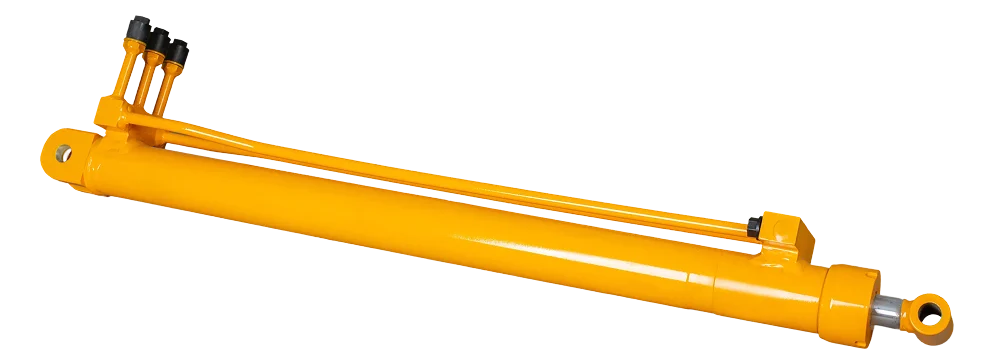
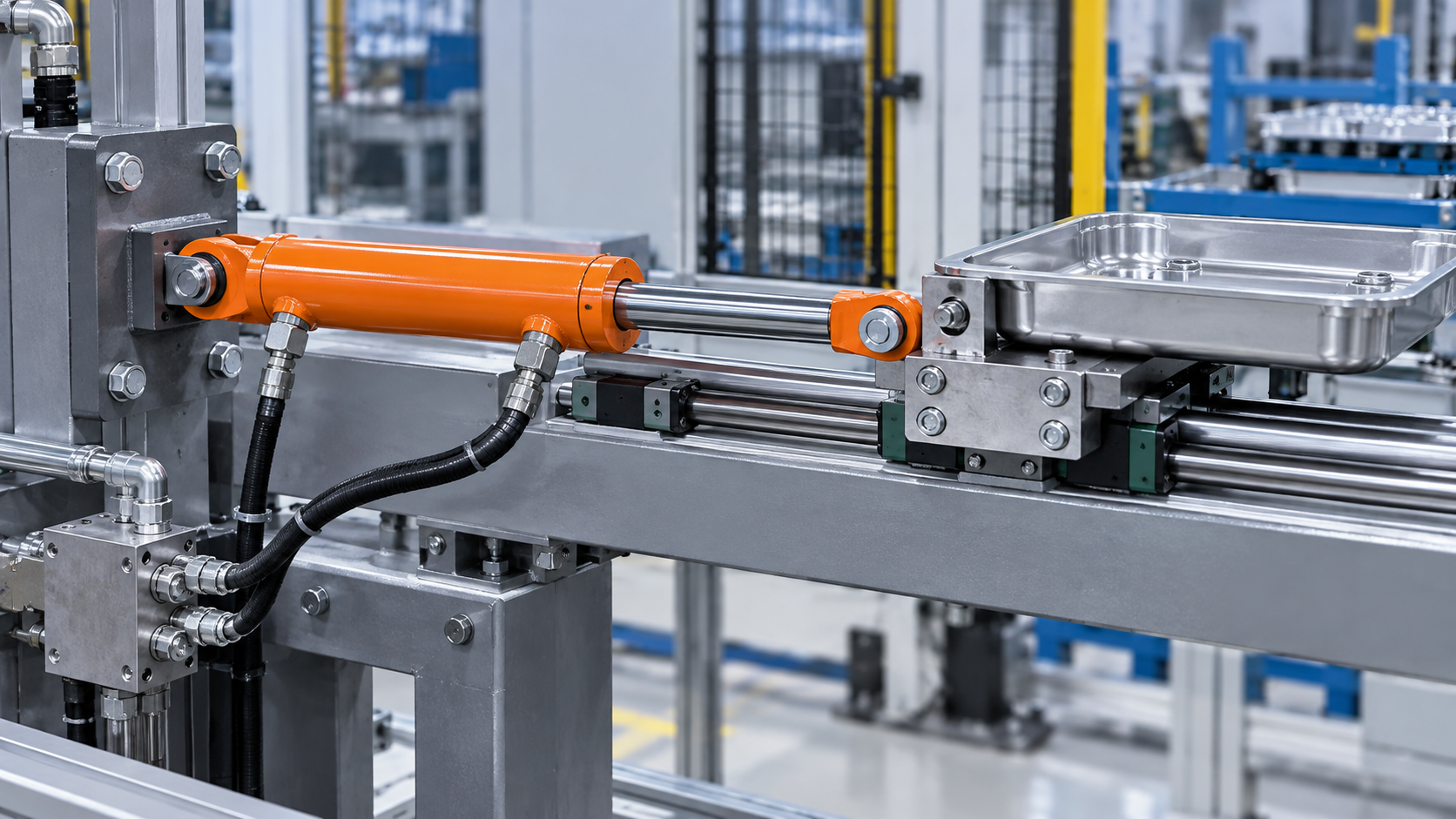
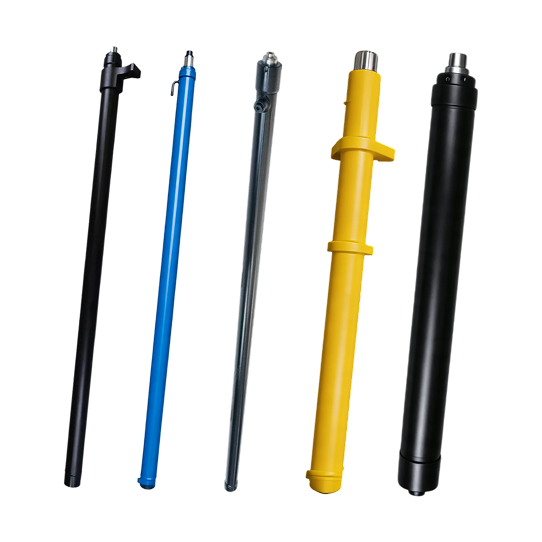
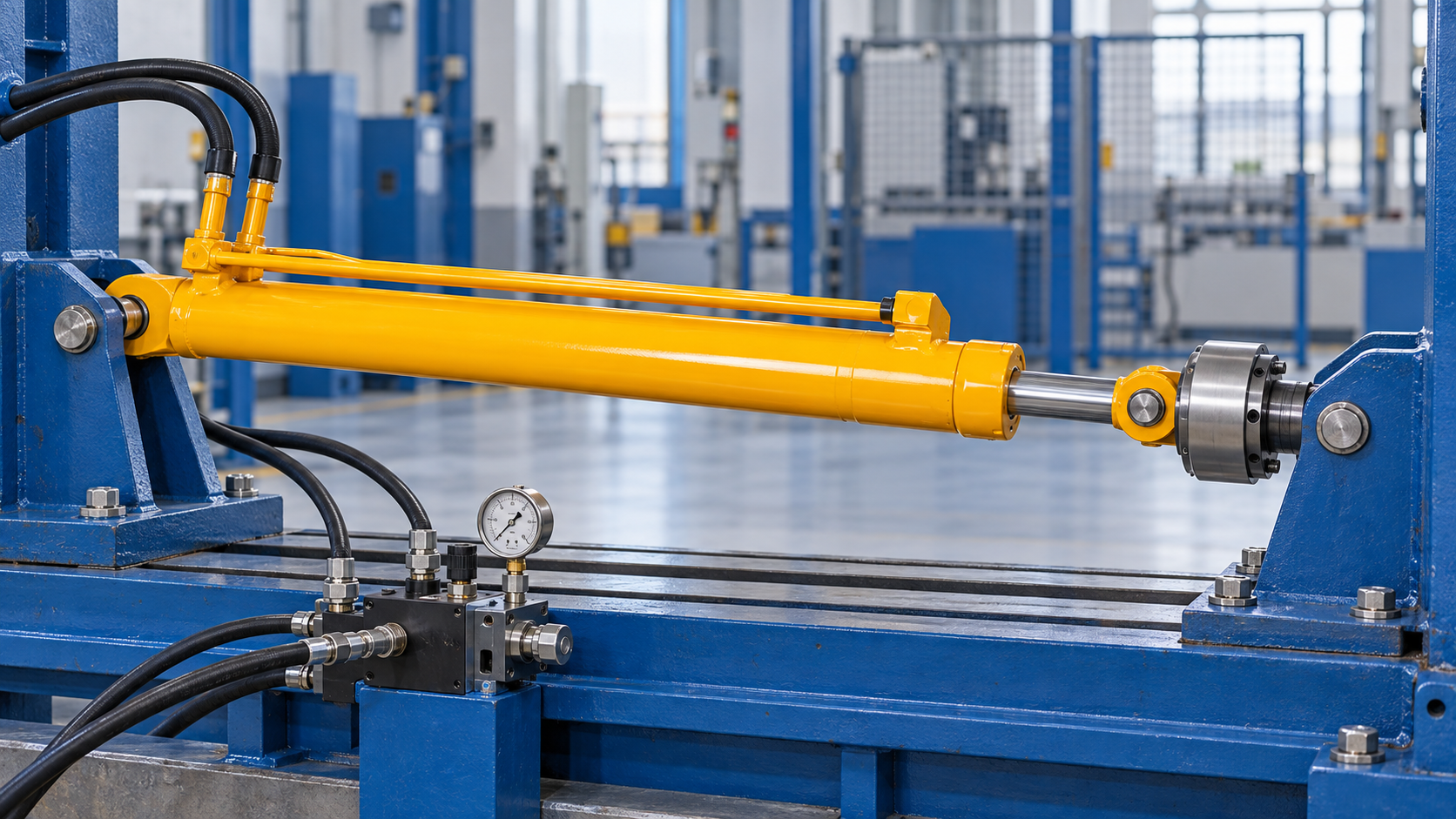
What actually happens inside a hydraulic cylinder when you operate the machine? Pressurized oil moves the piston, and the rod carries that movement to the load. The barrel contains the oil; the head and base close the cylinder, and seals and guides help the moving parts work together. Here are five groups of parts in a conventional piston-and-rod cylinder, starting with what you can see from the outside.
Hydraulic Cylinder Barrel
The barrel is the main steel tube between the end closures. Its inside surface gives the piston a smooth path to travel and holds pressurized oil in the working chambers. You usually see the outside of the barrel, but you cannot judge the condition of its bore from a quick external look. In the Bosch Rexroth hydraulics reference, this tube is labeled the cylinder pipe in a typical double-acting layout.
If you see a dent or a serious impact mark on the barrel, do not assume it is cosmetic: the inner running surface may also be affected. A cylinder that binds or moves unevenly might have bore damage, although misalignment or contamination can feel similar.
Hydraulic Cylinder Piston
Inside a conventional double-acting cylinder, the piston travels in the barrel and separates the two oil chambers. The pressure difference across it creates the push or pull at the rod. A piston seal helps keep oil from slipping directly from one side to the other; the piston and seal are different parts, even when you talk about them together.
You cannot see the piston while the cylinder is assembled. If a load drifts when it should hold, internal leakage past the piston seal may be one cause. Leakage through a control valve or elsewhere in the circuit can look much the same, so drift is a clue, not proof. Keep people clear of the load and have it supported as the machine maker specifies before anyone inspects the cylinder. Our separate guide to how a hydraulic cylinder works covers the oil-path sequence; here, the useful point is what the hidden divider does.
Do not apply this layout blindly to every product called a ram. Parker’s fluid-power sealing guide distinguishes piston-style cylinders from plunger arrangements that do not use the same piston-and-rod construction.
Hydraulic Cylinder Piston Rod
The piston rod connects the moving piston to the machine outside the barrel. Its polished surface passes through the rod-end head each time the cylinder extends or retracts. That exposed length is where you can spot a nick, rust, or recurring drops of oil before you know what is happening inside. A light lubricating sheen by itself is not the same as an external leak.
A scratch on the rod may cut or wear the rod seal as it travels through it. Repeated wet buildup or drops along the rod may point to that seal, but surface damage and the actual leak origin matter too. A bent rod or side load can make the motion feel tight and may increase wear at the head; neither symptom identifies a single failed part by itself. If you are comparing an application-specific unit, Jiangxin’s custom hydraulic cylinder range is a better reference than assuming every rod has the same mounting and stroke.
Hydraulic Cylinder Head and Base
The head closes the rod end of the barrel and provides the passage and support for the rod. The base closes the opposite end and often carries a mounting point. Ports, seals, and fastening details vary by design, so treat these as two functional ends, not as a universal parts list. Bosch Rexroth labels both ends separately in its standard cylinder drawing.
If oil appears around an end joint or a port, the source may be a static seal, a fitting, or damage nearby. Where the oil first wets the metal matters more than where it finally drips. At the rod end, looseness or uneven rod contact may also involve the head’s guiding parts.
Hydraulic Cylinder Seals, Guides, and Wipers
This fifth group contains several small parts, not one interchangeable item. A piston seal limits leakage between chambers. A rod seal keeps oil inside as the rod moves out. A wiper scrapes dirt from the returning rod, while guide or wear rings carry side load and help keep metal surfaces apart. SKF’s hydraulic cylinder seal guides make these functions distinct.
You might see persistent wet buildup at the rod end, dirt gathering at the head, or a change in how smoothly the rod moves. Those signs can suggest a seal, wiper, or guide problem, but they can also start with a scored rod, side load, or dirty oil. In a working machine, the small parts are only as effective as the surfaces and alignment around them.
If you are discussing a replacement or new build with us, share the cylinder model, dimensions, operating pressure, fluid, and the trouble you are seeing. Those details help us connect the symptom to the right design.
Hydraulic Cylinder Components FAQ
Is the piston the same as the piston rod?
No. The piston moves inside the barrel and divides the chambers; the rod links it to the external load.
Why do drops collect at the rod end?
Recurring drops can point to a worn rod seal or damaged rod surface; a light lubricating film alone is not proof of a leak.
Can a drifting cylinder mean a bad piston seal?
Yes, but it can also mean leakage elsewhere in the hydraulic circuit. Drift alone does not isolate the fault.
What keeps dirt out of a hydraulic cylinder?
The rod-end wiper helps clear contamination from the rod as it retracts; sound seals and a clean system matter too.
What does a hydraulic ram actually do in a machine? A forklift uses one to raise its fork carriage. A production line uses another to push a tray into position. On construction equipment, a cylinder can extend an outrigger beam. In each case, pressurized oil makes a piston or plunger move in a straight line. The type you need depends on the movement, how far it must travel, and how it returns.
How Does a Hydraulic Ram Work?
Oil enters the cylinder through a port and presses against a piston or plunger. That pushes the rod outward, lifting a carriage or moving a part along a guide. A valve controls where the oil goes next, so the machine can lower the load or retract the rod for another cycle.
Some rams use oil pressure for the outward stroke and rely on a load or spring to return. Others use oil pressure in both directions. That difference leads to the main types you’ll see on real machines.
What Types of Hydraulic Rams Are There?
You can group hydraulic rams by how they move or by how they are built. Single-acting and double-acting describe whether oil powers one stroke or both. Telescopic describes a cylinder with nested sections that extend from a shorter closed length. A telescopic ram can also be single- or double-acting.
Single-acting hydraulic ram
Oil pressure powers one stroke; the load, a spring or another mechanism brings the moving part back. A plunger ram is one single-acting design. It makes sense for lifting or pressing when that outside force can reliably return it. Before choosing one, ask what brings it back at every point in the cycle—not just when the machine is fully loaded.
Double-acting hydraulic ram
When you need a powered push and a powered pull, you’re usually looking at a double-acting cylinder. Oil acts on one side of the piston to extend the rod, then on the other side to retract it. A production-line pusher, for example, must move a part out and then clear the path for the next one. Jiangxin’s hydraulic pusher cylinder is offered for transfer, positioning, and ejection in automated lines. In that setting, return speed and repeatability matter as much as the forward push.
Telescopic hydraulic ram
A telescopic actuator nests several moving stages inside one another. It offers a long extended reach without requiring a one-piece cylinder of the same closed length. That is why telescopic designs suit equipment with limited stowed space, such as a tipping body. The trade-off is that available force changes as smaller stages extend; Enerpac’s telescopic-cylinder discussion notes the reduced load capacity farther out. You need enough force at the least favorable stage, not merely at the start of travel.
Where Are Hydraulic Rams Used?
You’ll find hydraulic cylinders doing different jobs in a warehouse, factory or on construction equipment. What changes from one job to the next is the movement the machine needs.
In a factory transfer station, a cylinder pushes a tray or workpiece into position and retracts before the next cycle. You care about the actual travel, the time allowed in each direction and how the moving part is guided. The cylinder supplies the push; it should not be asked to act as the carriage guide. Jiangxin’s automation-line pusher is one example of that role.
In a lift, the cylinder raises a load through a defined stroke. Forklift lifting cylinders do this in a mast; an automation-line lifting cylinder may instead raise a fixture or carrier at a fixed station. Both are lifting applications, but their mounting space, guidance and load-holding arrangements differ. Calling both “lift rams” does not tell you enough to swap one for the other.
On construction equipment, a hydraulic cylinder may move an outrigger beam sideways before the vertical support leg contacts the ground. Jiangxin’s horizontal outrigger cylinder is for that beam extension and retraction—not for jacking the machine upward. A telescopic cylinder in a tipping body solves a different problem again: gaining long lift travel from a compact resting length.
How Do You Choose the Right Hydraulic Ram?
Start with the motion. If you need a powered return, a gravity-return plunger is a poor fit. If the machine only needs to lift and the load provides a dependable return, a single-acting design may be enough. If it must travel far but fit into a short stowed space, consider a telescopic arrangement and check force through the full extension.
Then look at what the cylinder is actually pushing. The required force depends on more than the object’s weight: friction, the angle of movement and the geometry of a linkage can all change the load seen by the rod. The stroke must cover the useful travel without running the machine into its end stops. A long exposed rod also needs a suitable mounting and guidance arrangement; side load is a job for the machine structure, not the rod seal.
Finally, think about what happens when movement stops. Does the load need to stay raised? Must the cylinder stop gently near the end of its stroke? Will dust, washdown or frequent cycling affect the rod and seals? Those answers shape the complete hydraulic setup, not just the cylinder body. If you’re comparing custom hydraulic cylinders, describe the job in those terms and it becomes much easier to identify a suitable design.
Two cylinders with the same nominal force and stroke can behave very differently in the same machine. Before choosing one, look at how it returns, how much room it has when retracted and what load it faces throughout the stroke.
Hydraulic Ram FAQ
Can a hydraulic ram work horizontally?
Yes. A double-acting cylinder can push a horizontal load out and pull it back under hydraulic power. A single-acting plunger can also push horizontally, but it needs a spring or another external mechanism to return it; gravity alone will not pull it back along a level path.
Will a hydraulic ram hold a load when the pump stops?
Don’t assume it will. A cylinder supplies force while the circuit controls the oil. If a raised load must remain in place, the machine needs an appropriate load-holding arrangement, such as a suitable valve or mechanical support. The cylinder’s lifting capacity alone does not answer that question.
How much weight can a hydraulic ram lift?
No single load rating applies to every ram. The available force depends on its working area and operating pressure, while the machine’s mounting and structure also limit what it can lift safely. Use the rating for the complete lifting setup, not the cylinder’s force alone.
Watch an excavator pick up a bucket of soil. Your eye probably follows the bucket, not the polished rod moving beside its linkage. But the rod is what turns the bucket: it travels in a straight line, and the linkage turns that stroke into an arc. Inside the hydraulic cylinder, oil presses on a piston attached to the rod.
Follow that rod through a full cycle. Oil enters one side of the piston while oil leaves the other. Swap those paths, and the rod changes direction. That is the basic job of a double-acting Hyd Cylinder. The less obvious part is why it can push harder in one direction yet move faster in the other. The answer sits in the piston’s two working areas and the amount of oil flowing through the ports.
Inside the Hyd Cylinder
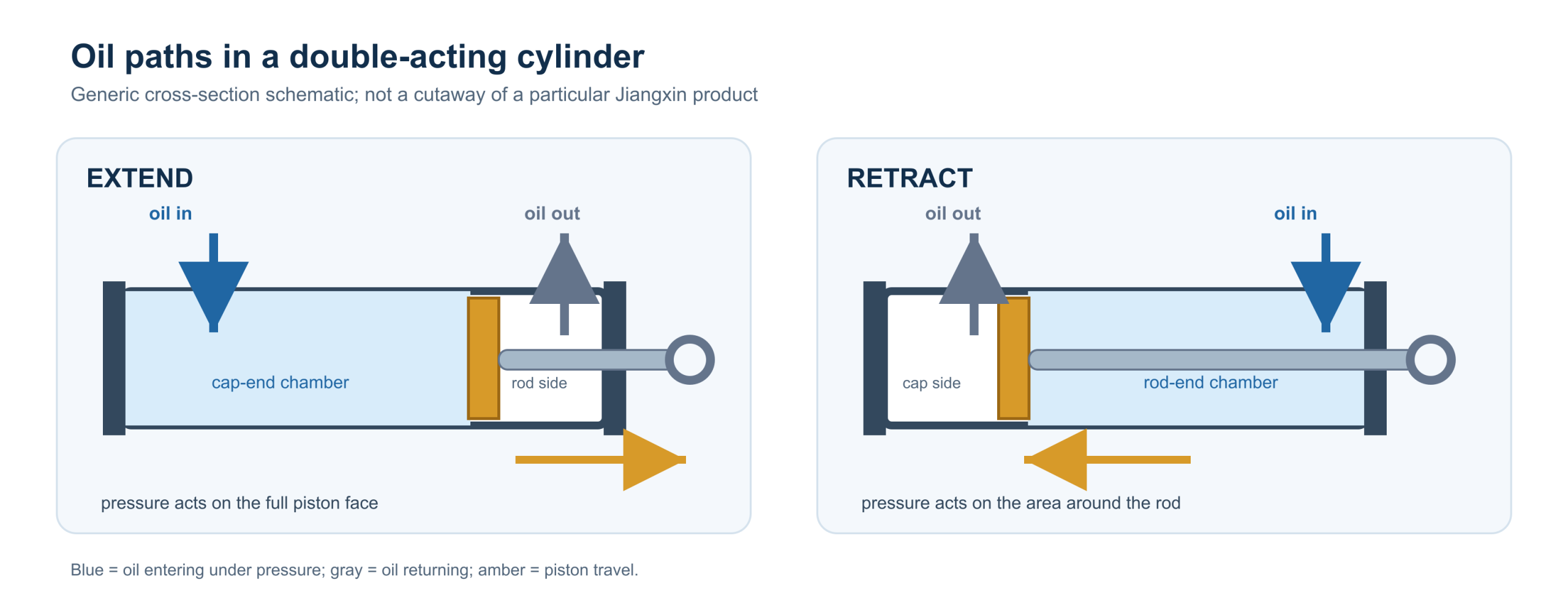
Imagine the barrel with its rod hidden inside. The rod is fixed to a piston that can slide along the bore. As it moves, the piston divides the barrel into two spaces: the cap-end chamber behind its full face and the rod-end chamber around the rod. Oil reaching either space pushes on the piston and moves the rod with it.
The seals have different jobs. A piston seal limits oil slipping from one chamber to the other. At the head, a rod seal keeps oil in, a wiper clears dirt from the returning rod, and guide rings help the rod travel straight. The two ports connect those chambers to the machine’s oil lines, while the mounts transfer the rod’s push or pull to the linkage. If you want to see how the barrel, rod, and seals are made and fitted, our hydraulic cylinder manufacturing process article follows them through the workshop.
Oil Paths Through the Cylinder
When the rod extends
To send the rod out, the control valve directs oil to the cap-end port. Oil presses against the piston’s full circular face, moving the piston toward the head. Oil already in the rod-end chamber needs somewhere to go, so it flows out through the other port and back toward the reservoir. Both lines are working at once: one feeds the moving chamber, and the other lets the opposite chamber empty.
When the rod comes back
Move the valve the other way and the oil paths reverse. Oil enters the chamber around the rod, pushing on the ring-shaped area of the piston. Oil at the cap end leaves through its port. Pressure does not pull the piston back; it pushes from the opposite side, taking the rod into the barrel. The diagram below lets you trace both paths at a glance.
Why Cylinder Force Changes
If you know the oil pressure, can you work out how much force the rod will push? Not without the piston area. Oil pressure acts across that area, and the rod takes up part of it on the return side. Enerpac explains the pressure principle, while Yuken’s hydraulics manual gives the cylinder calculation:
Theoretical force = pressure × effective piston area
Here is a simple example, not a specification for the photographed Jiangxin product. Give a cylinder a 100 mm bore, a 50 mm rod, and 160 bar at the working port. On extension, oil sees about 7,854 mm² of piston area, so theoretical rod force is 125.7 kN. On retraction, the rod occupies 1,963 mm² of that face. Oil has only about 5,890 mm² to push against, giving 94.2 kN at the same pressure. To check those figures in metric units, multiply bar by mm² and divide by 10,000 for kN.
That difference is built into a single-rod cylinder. It does not mean a machine delivers exactly 125.7 kN at the bucket or fork. Pressure in the line emptying the opposite chamber resists movement, seals add friction, and the linkage changes force at the load as its angle changes. If you are sizing a cylinder for a machine, use pressure measured at its ports and the actual linkage drawing, not a pump rating alone.
How Fast Can the Cylinder Move?
Think about how much oil each side needs for the same distance of rod travel. The cap end has a larger working area, so it needs more oil for each millimeter of extension. The rod side has less space to fill. That is why a cylinder can retract faster than it extends when the same flow reaches either active port. HAWE’s cylinder-velocity reference expresses ideal speed as flow divided by effective piston area.
Use the same example: 100 mm bore, 50 mm rod, with 20 L/min actually arriving at the active port. Ideal extension speed is about 42 mm/s; ideal retraction speed is about 57 mm/s. Turning up pressure while keeping port flow unchanged does not automatically make either stroke faster. The pump and valve must deliver enough flow under load, and restrictions or leakage can change the speed you see on the machine.
Some cylinders ease into the end of a stroke because built-in cushioning meters oil leaving the opposite chamber. That slowdown can be intentional. When we discuss a custom hydraulic cylinder, your required travel time and available port flow tell us more about speed than the pressure rating alone.
One or Two Powered Cylinder Strokes?
Not every cylinder uses oil to move both ways. A double-acting cylinder has a working port on each side of the piston. A forklift tilt cylinder, for example, needs controlled forward and backward mast movement; Ognibene documents a double-acting tilt design. Jiangxin’s forklift cylinder range also separates lift, tilt, reach, and steering applications rather than treating them as one interchangeable cylinder.
A single-acting cylinder uses oil pressure for one powered stroke. A spring, gravity, or the load returns it as oil leaves through its working port. Forklift lifting is a familiar case: HydraForce describes a typical single-acting lift circuit. A telescopic cylinder can also be single- or double-acting; its nested stages tell you how far it can reach from a short closed length, not what powers its return. Check the drawing and circuit before assuming a second port or a powered return.
Hyd Cylinder Questions
Can a cylinder stop halfway and hold a load?
You can stop the rod before the end of its stroke by stopping flow through the directional valve. Whether it will hold a load is another matter. Valve position, internal leakage, and load-control devices all affect that. Never rely on the cylinder alone to support raised equipment while you work beneath it; follow the machine maker’s blocking procedure.
How much oil does one stroke need?
Multiply the effective piston area by the stroke length. For the illustrative cylinder above, a 100 mm extension needs about 0.785 L at the cap end. A 100 mm retraction with the 50 mm rod needs about 0.589 L at the rod end. If you know the flow reaching the port, those volumes also give you an ideal travel-time estimate.
Why does a cylinder slow just before it stops?
Look for an end-of-stroke cushion in the cylinder drawing. A cushion meters outgoing oil over the final part of travel, letting the piston reach the end more gently. Valve commands and changing linkage load can affect speed too, so check those before deciding what caused the slowdown.
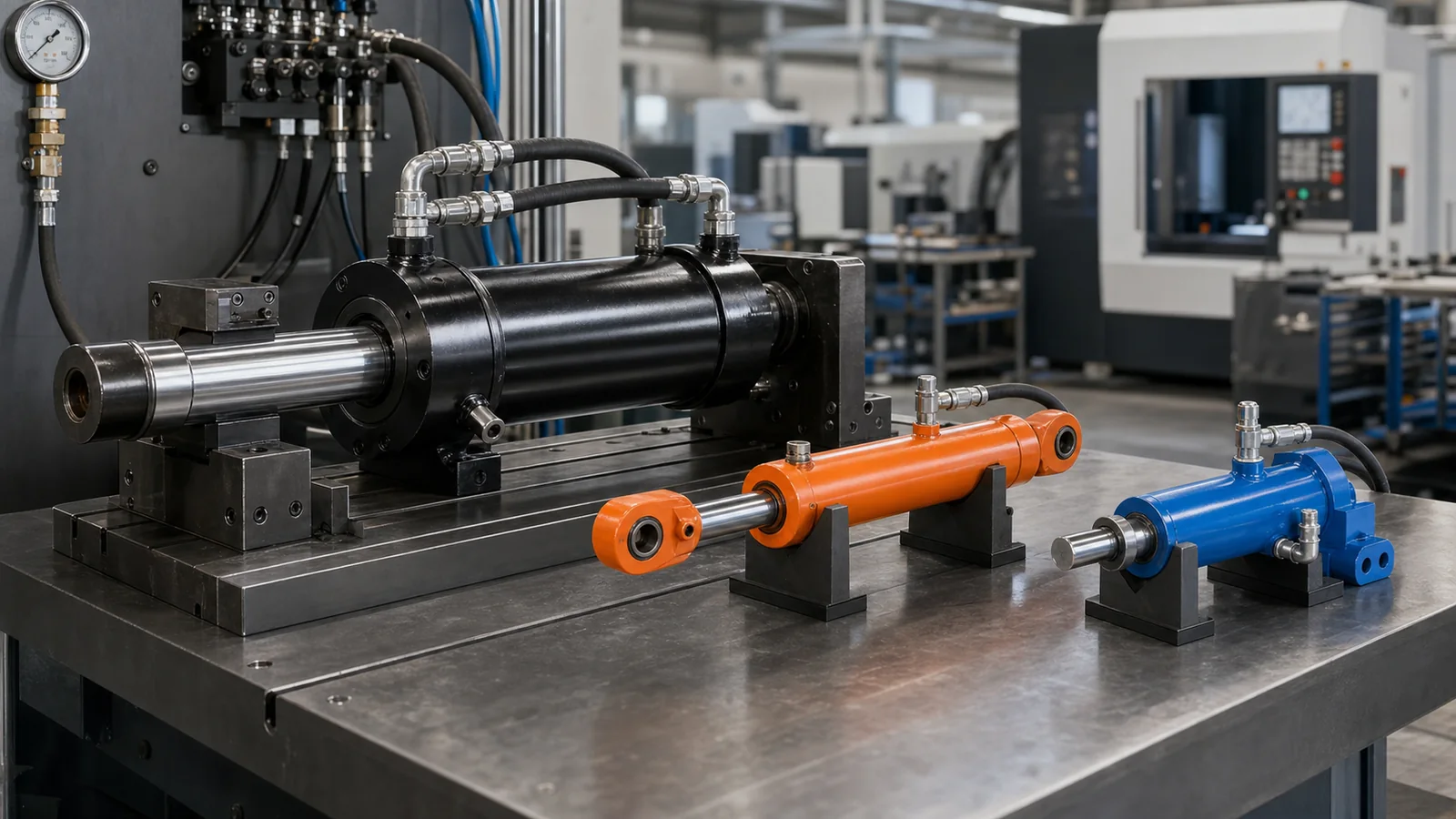
An excavator arm, a farm implement, and a factory press may all use hydraulic cylinders, but they do not need the same cylinder. Stroke, mounting points, working pressure, and operating conditions vary by machine. Before the barrel is cut or the rod is turned, those requirements have to be settled on the drawing.
In hydraulic cylinder manufacturing, that drawing guides material selection and the machining of each part. Then the body is joined, clean parts and seals are assembled, and the completed cylinder is run through its stroke and pressure-tested. We’ll take you through that work so you can see what goes into the cylinder you order.
Start Hydraulic Cylinder Manufacturing With the Drawing
Say your replacement cylinder passes a pressure test, but its hose port faces a frame rail. You still cannot install it. Before anyone cuts the tube, check the bore, rod diameter, stroke, closed length, pin centers, mount widths, and port direction against the machine. Working pressure, fluid, temperature, and exposure to dirt or water also belong in the specification because they affect the seals and rod finish.
If you have the old cylinder but no drawing, send photographs of both ends, the ports, and the installed position. Measure the mounting centers with the rod retracted and extended. Tell us if the old unit leaked at the rod, drifted under load, or bent. Those observations help define the custom hydraulic cylinder you actually need. An approved drawing gives machining and inspection the same set of dimensions to work from.
The material list follows the drawing. A barrel, rod, piston, gland, mounts, and seals must work together at the specified pressure and in the specified environment. Buying a stronger rod or a more expensive seal by itself does not fix a wrong fit.
How the Hydraulic Cylinder Barrel Is Machined
The barrel starts as tube stock. It is cut to length, and its ends, ports, and connection features are machined. The inner bore is then brought to the size and finish required by the drawing. Some builds start with a precision-honed tube; others need boring and honing as separate operations. For its horizontal outrigger cylinder, Jiangxin specifies a 20# steel precision-honed seamless barrel. Different cylinders may require different stock.
The inside surface is where the piston seal travels. If the bore is tight halfway along the stroke, the piston can drag even when the opening measures correctly. Diameter, roundness, and finish therefore need checking at the positions the drawing requires. Port edges must be free of burrs before a seal passes them during assembly.
This is also the point to ask about the build sequence. Welding can move a tube slightly. When a design calls for welding after a bore is finished, the bore condition needs checking after that heat is applied. A measurement taken only before welding cannot answer that question.
Machining the Hydraulic Cylinder Rod and Small Parts
The rod is machined for its piston connection and its external thread, clevis, or eye. Its sliding surface then needs the diameter, straightness, and finish specified for the gland and rod seal. On Jiangxin’s horizontal outrigger cylinder, the listed rod is 45# steel with standard hard-chrome plating; the product page also offers other surface treatments. If your cylinder works around salt spray or abrasive dust, call out that exposure on the drawing instead of assuming the standard finish will suffice.
Before assembly, inspect the area the seal will contact. A raised nick or coating defect may be small enough to miss in a quick glance, yet the seal will cross it on every stroke. Rod-end threads and pin holes deserve the same attention. They may not affect a bench pressure test but can stop the cylinder from fitting your machine.
The piston and gland need their own machining checks. Their grooves hold the seals and wear elements, and their machined faces close the pressure boundary. Check groove dimensions, edges, and mating surfaces against the selected seal set before cleaning the parts for assembly.
Welding the Hydraulic Cylinder Body
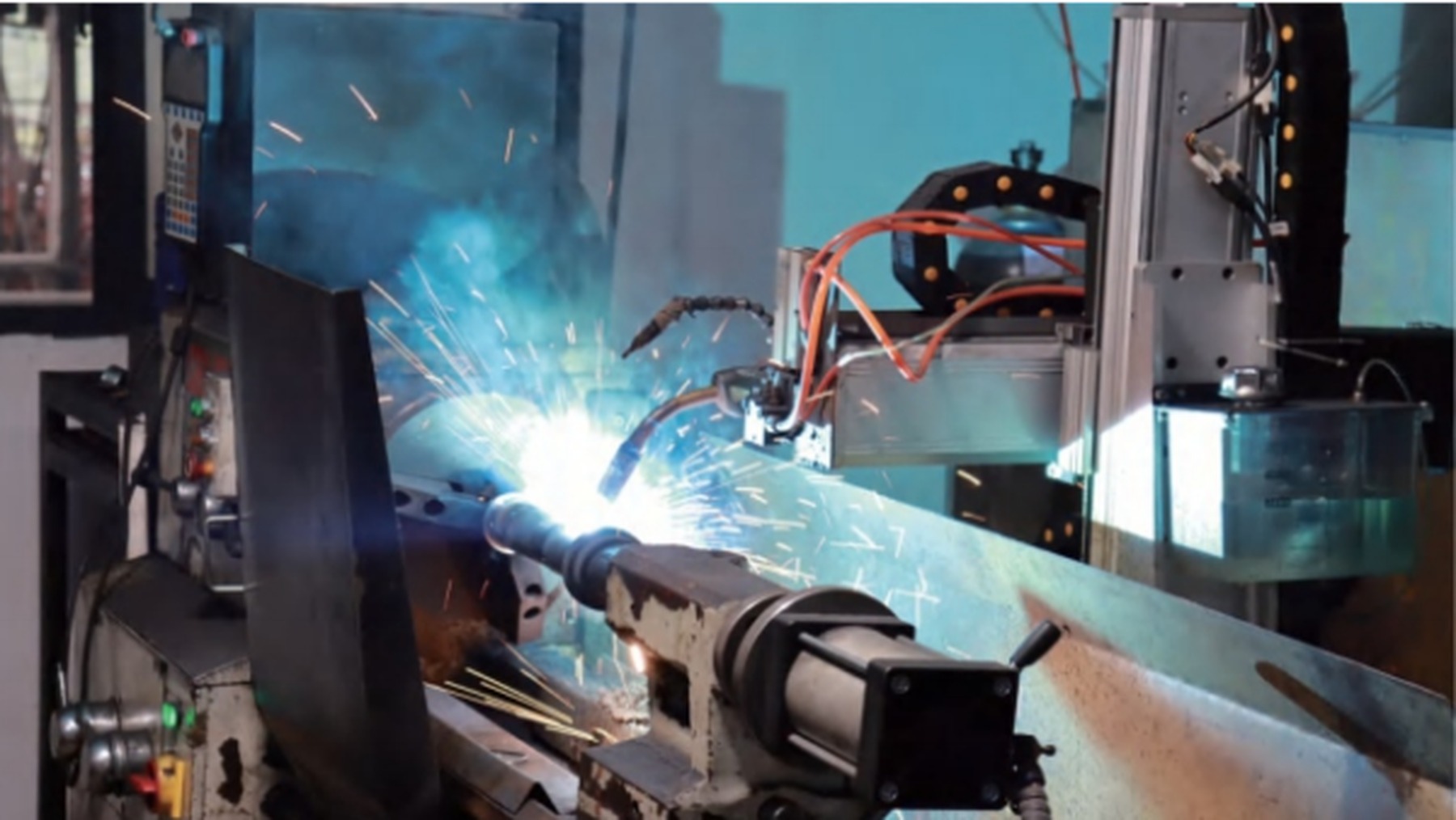
For a welded cylinder, the cap, ports, or mounting parts are located on the barrel and joined according to the drawing. The fixture must hold the mounting eyes and port direction where the finished cylinder needs them. A neat weld does not help if the pin bores end up out of line.
Jiangxin’s horizontal outrigger cylinder page identifies robotic welding for that model. In the workshop photo below, the part is held in a welding fixture while the joint is made. After joining, recheck the relevant mount dimensions, alignment, and bore condition. Some designs call for final bore work after welding; others protect a finished bore through the weld sequence.
Does a tie-rod cylinder skip this step?
A tie-rod design uses rods and end caps to clamp the barrel together instead of the same welded barrel-to-cap joint. Its parts still need accurate machining and alignment. The joining method changes, but the piston must still travel freely, and the assembled joints must still seal.
Clean Assembly for Hydraulic Cylinder Seals
Chips, abrasive residue, and welding debris must be removed before the piston goes into the barrel. A particle left behind can score the bore or cut a seal during the first few strokes. Clean parts are protected while the seals, wiper, and wear elements are fitted into their grooves.
The piston is secured to the rod, then the rod-and-piston assembly is guided into the barrel without dragging the seals across a sharp edge. The gland closes the rod end, and the remaining joints are completed for that construction. If a seal twists, a groove edge cuts it, or a rod gets scratched during insertion, good machining will not prevent a leak.
Before closing the body, check that the parts are clean and the seals sit in the correct grooves and orientation. Then move the rod through its travel and check for binding. Welded, threaded, and tie-rod bodies need different closing steps, but none can skip those basic checks.
How We Test a Finished Hydraulic Cylinder
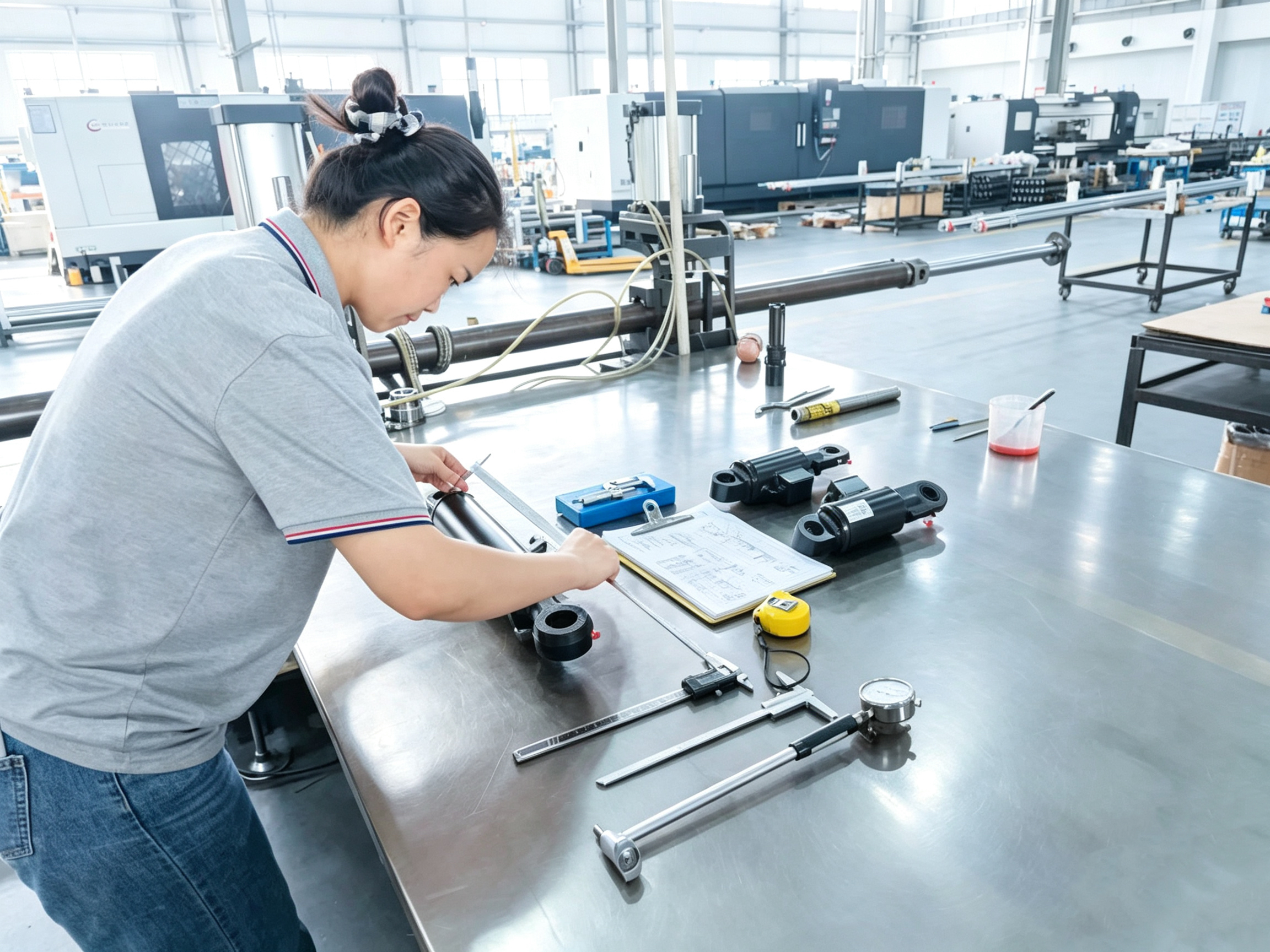
We stroke the assembled cylinder through its specified travel. The test checks movement, end positions, and any cushioning or sensor features fitted to that unit. We then check pressure and leakage against the agreed drawing and test plan. A short clamping cylinder and a long-stroke construction cylinder should not be judged against an invented one-size-fits-all pressure figure.
ISO 10100:2020 specifies acceptance and function tests for hydraulic fluid-power cylinders. It provides a useful reference when the buyer and manufacturer agree on how to accept a unit. The order still needs its own rated pressure and any application-specific acceptance criteria.
If oil appears at a port or rod end, find the cause and retest the cylinder after correction. A wipe-down is not a passed test. Once the unit passes, cap the ports, protect the exposed rod, and identify the cylinder against the order. A damaged thread or scratched rod during shipping can undo the work done in the shop.
If you need a test record, dimensions, or material documents with a custom order, request them when you send us the drawing. Then everyone knows which checks and records belong to that cylinder before production starts.
Hydraulic Cylinder Manufacturing FAQs
Can welding change a finished cylinder bore?
Yes. Heat and restraint can move the tube enough to affect the bore. The required inspection point depends on the design and welding sequence, but a pre-weld bore measurement alone does not establish the finished condition.
What can make a new cylinder leak on its first test?
A cut or twisted seal, a nicked rod, a damaged bore, debris inside the barrel, or a leaking port joint can all cause it. Where the oil appears helps narrow the search. Repair and retest the cylinder, not just wipe it clean.
Do all cylinders need the same manufacturing steps?
No. A welded body needs joining and post-weld checks; a tie-rod body uses clamped end caps. Starting with honed tube also changes the barrel machining route. Both designs still need parts that fit, clean assembly, and a final test against their own specification.
What proof should I request after factory testing?
Ask for confirmation that the finished cylinder matches the approved drawing and has passed the agreed functional and pressure checks. If you need a recorded pressure result, measured dimensions, or material traceability, put those requirements on the order before the build begins.
The hardest part of choosing a hydraulic cylinder manufacturer is not finding a company that can make a cylinder. It is finding one that understands your machine, gives you a complete quote, and delivers the same build after the sample has been approved.
We often see buyers start with price and discover the missing details later. The quoted cylinder arrives with the wrong port direction. The mounting centers do not match the machine. The sample works, but the next batch uses a different seal. These problems are expensive because the lowest-priced component can stop a much more valuable piece of equipment.
You can avoid most of that risk with a practical comparison. Start with the cylinder your machine needs, then see how the manufacturer responds before, during, and after production.
First, Match the Hydraulic Cylinder to Your Machine
A manufacturer may produce good cylinders and still be the wrong supplier for your project. Before asking for a price, check whether it regularly builds your cylinder type, size, and application.
A welded cylinder for construction equipment is not the same job as a compact cylinder for an automated production line. Loads, side forces, mounting space, duty cycle, and environmental exposure all affect the design. If you need a telescopic cylinder, position sensor, special coating or non-standard mounting, ask for examples of comparable work. A general statement such as “we can customize anything” tells you very little.
Send the supplier the information that affects the build: bore, rod diameter, stroke, closed length, pressure, mounting, ports, temperature, cycle frequency, and hydraulic fluid. Add a drawing or sample when available. If some details are unknown, explain what the machine does and where the cylinder is failing.
Our custom hydraulic cylinders process can begin with a drawing, an existing sample, or operating requirements. That first technical exchange should help you confirm whether the supplier understands the application before you discuss a final price.
Listen to the questions you receive
A useful reply does more than repeat your dimensions. The engineer may ask about an off-center load, available installation space, cushioning near the end of stroke, or corrosion around the machine. Those questions show that someone has considered how the cylinder will work. If the supplier sends a quote without clarifying an incomplete specification, treat the speed of that reply as a warning, not a benefit.
Engineering Support Reveals the Manufacturer
You do not need a long presentation from the engineering team. You need clear answers that reduce the chance of a wrong build.
Ask the supplier to return a drawing or specification for approval. Compare it with your original information and check the mounting centers, closed length, stroke, port orientation, and any interface that connects to your machine. If the manufacturer proposes a different rod size, seal material, or surface treatment, the reply should explain why the change suits your working conditions.
This is also the time to notice communication habits. Does one person own the technical questions? Are drawing revisions dated? Can the team explain a recommendation in plain language? A factory that loses track of a revision during quoting may do the same after production starts.
For a replacement cylinder, do not accept a visual copy as the entire engineering process. Two cylinders can look alike while using different materials, tolerances, or internal cushioning. Make sure the supplier knows the operating pressure, load, and failure symptoms, not just the outside dimensions.
What Does a Good Hydraulic Cylinder Quote Include?
Two quotations are not comparable until they cover the same specification. A low number may exclude a sensor, coating, test, export crate or delivery term that another supplier included.
A useful quotation identifies the cylinder configuration, key materials, seal option, surface treatment, quantity, sample charge, production lead time, testing, packaging, warranty, and trade terms. Show custom tooling or drawing fees separately. If the offer uses phrases such as “standard material” or “normal testing,” ask the supplier to name what will actually be supplied.
Request sample, pilot-batch, and production quantities so you can see how the cost changes. Ask how long the price remains valid and what could change it. This gives you a better comparison than one headline price.
A cheaper cylinder can create a costly stop
Consider what happens if a cylinder leaks after installation. The direct replacement cost may be small compared with technician time, freight, machine downtime, and missed production. Your purchasing decision should reflect the cost of failure in your application, not only the unit price on the quotation.
Look Beyond the Manufacturer’s Sample
A polished sample proves that the factory can make one acceptable cylinder. It does not prove that the fifth or five-hundredth unit will match it.
Agree on what the sample must demonstrate before building it. That may include installation dimensions, full stroke, movement, pressure holding, external leakage, cushioning, sensor output, or performance on your machine. Keep the approved drawing and test result with the sample so both sides know what production must match.
For a new design, a small pilot order lets you see whether several cylinders operate consistently. If your application runs frequently, do not judge it after a few workshop strokes. When practical, test it under a realistic load and cycle pattern.
Ask how the factory handles a change after sample approval. A seal, port, material, coating, or dimension should not change silently because a component became difficult to source. You should receive the proposed change and decide whether another sample or test is needed.
Testing Should Fit the Hydraulic Cylinder’s Job
“Every cylinder is tested” sounds reassuring, but it is incomplete. Ask what is tested, at what pressure, for how long, and which result is recorded.
At a minimum, the test should match the agreed drawing and purchase requirements. Depending on the application, that can include dimensional inspection, stroke, pressure holding, internal or external leakage, cushioning, and sensor checks. A cylinder used on construction machinery may face shock, dirt, and outdoor exposure, while a unit for an automation production line may need repeatable motion and reliable position feedback.
You do not need to ask for a stack of paperwork with every low-risk order. You do need enough information to identify the batch and confirm that the agreed test was completed. For a critical application, decide in advance whether you need individual serial numbers, material records, or a detailed test report.
When you visit the factory or join a video call, ask to see an ordinary cylinder being assembled and tested. Clean components, protected ports and an organized test area often tell you more than a staged photograph. You can also ask the operator what happens when a cylinder fails the test. A clear answer should include isolation, correction, and retesting—not simply “we check it again.”
Can the Manufacturer Meet Your Real Lead Time?
A four-week lead time is useful only if the manufacturer can explain when those four weeks begin. Does the clock start after payment, drawing approval, material arrival, or sample confirmation?
Ask for separate timings for technical review, sample production, and repeat orders. If your demand is seasonal, share a realistic forecast and ask how the supplier reserves material and machine capacity. A credible manufacturer may not promise the shortest time, but it should explain the schedule and warn you early when something changes.
Order size matters too. Some factories are comfortable with one replacement cylinder but struggle with repeat batches. Others prefer volume and give small orders little attention. Tell the supplier your expected annual quantity, normal batch size, and likely growth so you can see whether the relationship fits both sides.
Packaging belongs in this discussion. Rod surfaces, ports, and machined mounts need protection during storage and international transport. Confirm whether the quoted package is suitable for the route rather than discovering damaged threads or corrosion after delivery.
Manufacturer Support After Delivery
Before placing an order, ask what happens if a cylinder does not fit or fails in service. Who reviews the problem? What photographs, measurements or operating information will the team need? How quickly will you receive an initial response?
A useful warranty states the period, coverage, and exclusions in writing. It should also explain the practical remedy—repair parts, replacement, credit or another agreed solution. Be cautious when a supplier promises that “all problems will be solved” but cannot describe a process or name a responsible contact.
Spare seals and wear parts may be important if your equipment operates far from your maintenance base. Ask whether the manufacturer can supply a seal kit with a clear part reference and whether production drawings will remain available for repeat orders. This is especially valuable when the cylinder is built for your machine rather than purchased from a standard catalog.
Red Flags When Choosing a Cylinder Manufacturer
You do not need a formal audit to spot early risk. Slow technical answers, unclear drawings, and changing specifications are often enough to pause a project.
Watch for a quote issued from incomplete information, reluctance to show similar products, unexplained material substitutions, a sample without an approved drawing, vague testing claims, or a price that changes whenever you ask what is included. Poor version control is another serious sign: if two people send different drawings, stop until you establish one approved revision.
Also notice whether the supplier pushes you to confirm the order before closing the technical questions. A good manufacturer wants the cylinder to fit the first time. It should be willing to slow down for one clear engineering decision rather than rush toward a deposit.
The final choice is rarely the factory with the longest equipment list. It is the one that understands your machine, defines the build clearly, proves the sample, explains the production schedule, and remains reachable when you need help. If you are comparing a new or replacement design, send your working conditions and drawing through our contact page. We can review the application with you before preparing the quotation.
Questions Buyers Ask a Hydraulic Cylinders Manufacturer
What should I send to get an accurate hydraulic cylinder quote?
Send a drawing or sample details plus bore, rod diameter, stroke, closed length, mounting, ports, working pressure, quantity, and operating conditions. Mention side loads, temperature, corrosion, high-cycle frequency, cushioning, or sensors. The more clearly you define the application, the fewer assumptions will appear in the price.
How can I tell whether a hydraulic cylinder manufacturer is reliable?
Look at how the supplier handles a real project. It should ask relevant questions, return a controlled drawing, state what the quote includes, agree on sample tests, and explain lead time and warranty. Similar products, a live factory view, and consistent answers from sales and engineering provide stronger reassurance than broad claims.
Should I buy a standard cylinder or order a custom one?
Choose a standard cylinder when its dimensions, mounting, pressure rating, and environment already fit the machine. A custom cylinder makes sense when a catalog model can’t safely meet space, stroke, ports, load, mounting, or operating conditions. Compare the cost of modification with the downtime and redesign risk of forcing the wrong cylinder into the application.
How long does a custom hydraulic cylinder sample take?
There is no honest universal lead time. It depends on drawing approval, materials, tooling, machining, surface treatment, and testing. Ask the manufacturer to separate engineering-review time from production time and confirm the start point in writing. That makes the schedule easier to manage if the drawing changes.
Why are two hydraulic cylinder quotations so different?
The suppliers may be pricing different materials, seals, coatings, tests, quantities, packaging, or delivery terms. Put both quotations side by side with the same approved specification, and ask each company to identify exclusions. Do not assume the higher or lower price represents the same cylinder.
Picking the right hydraulic cylinder supplier isn’t just about matching a pressure rating and grabbing the lowest quote. You need a cylinder that actually fits your machine, takes a beating on the job, comes with real inspection papers, and stays consistent when you reorder down the line. We put this list together for
How We Compared Industrial Hydraulic Cylinder Suppliers
We looked for a documented industrial cylinder range, evidence of custom or configurable production, useful engineering information, and a clear fit for OEM or industrial buyers. We also considered whether a supplier covers common formats such as tie-rod, mill-type, welded, telescopic, compact, or sensor-equipped cylinders.
Before requesting quotes, define these points in one RFQ: bore, rod diameter, stroke, retracted and extended length, operating and test pressure, push/pull force, speed, duty cycle, mounting geometry, port type and orientation, fluid, temperature, rod coating, seal material, paint system, inspection documents, annual volume, and delivery location. That same data makes supplier comparisons much cleaner.
10 Industrial Hydraulic Cylinder Suppliers to Shortlist
1. Jiangxin Hydraulics
Jiangxin Hydraulics is a China-based OEM manufacturer focused on hydraulic cylinders for forklifts, aerial work platforms, construction machinery, and drawing-based industrial applications. We included our own company because buyers seeking batch OEM production often need more customization than a catalog cylinder offers. This is also a disclosure: Jiangxin publishes this guide, so you should compare our quotation against the same technical checklist used for every supplier below.
Our custom hydraulic cylinders can be specified around bore, rod, stroke, mounts, ports, pressure, and operating conditions. For repetitive clamping, pushing, positioning, or transfer, review our automation production line cylinder applications. Jiangxin is a practical candidate when you have an OEM drawing, repeat demand, and need factory-level engineering feedback before sampling.
2. Parker Hannifin
Parker Hannifin offers a broad industrial cylinder catalog covering heavy-duty, medium-duty, compact, roundline, metric, and electrohydraulic formats. Its online cylinder tools also support 2D/3D configuration and CAD downloads. Parker is worth shortlisting when your engineering team wants a mature catalog platform, multiple mounting options, and access through a large distribution network.
Ask the local Parker channel to confirm the exact series, regional availability, cylinder configuration code, and replacement support. A product listed globally may not have the same lead time in every market.
3. Bosch Rexroth
Bosch Rexroth supplies mill-type, tie-rod, and application-specific hydraulic cylinders. Its configurator allows selection by force, stroke, and installation position and includes a buckling calculation. That makes Rexroth especially relevant when a standards-based industrial design, engineering tools, and integration with a wider hydraulic system matter more than finding the lowest unit price.
For an RFQ, state whether you need a standard series, a modified catalog cylinder, or a fully application-specific design. That distinction will affect engineering time, interchangeability, and lifecycle cost.
4. Danfoss
Danfoss lists industrial tie-rod, welded, threaded, electrohydraulic, and XL custom cylinders. Its published applications include steel mills, bridges, hydropower, mining, processing, and machine tools. Danfoss is a strong candidate for severe-duty projects or systems that benefit from a cylinder, feedback transducer, and mounted control valve in one electrohydraulic package.
When comparing Danfoss with another supplier, check the complete control architecture—not just the actuator. Integrated sensing and valves can reduce assembly work, but they also change spares planning and commissioning requirements.
5. Hänchen
Hänchen manufactures industrial, DIN/ISO standard, servo, test, and custom hydraulic cylinders in Germany. Its Series 120 and 300 industrial ranges publish bore and pressure ranges, while sensor options support position or force feedback. Hänchen fits precision machinery, test systems, presses, and other applications where low friction, controlled motion, and engineering detail are primary buying criteria.
If interchangeability matters, ask whether the selected design follows ISO mounting dimensions. If response behavior matters more, provide speed, frequency, load profile, and measurement requirements with your RFQ.
6. Yates Cylinders
Yates Cylinders manufactures custom tie-rod, welded, and mill-duty cylinders and provides repair services through several US locations. The company describes customization around bore, stroke, mounts, ports, materials, seals, and coatings. Yates is a useful shortlist option for North American plants that want custom production and a repair path from the same supplier.
For brownfield equipment, send the original drawing, if available, along with measurements and failure history from the removed cylinder. A dimensional copy alone may reproduce the weakness that caused the previous unit to fail.
7. Aggressive Hydraulics
Aggressive Hydraulics focuses on custom welded, telescopic, integrated-valve, position-sensing, mill-duty, high-pressure, and stainless-steel cylinders made in the United States. It also offers configurable pre-engineered models for medium- and heavy-duty use. This supplier serves OEMs with unusual mounting, port, sensing, material, or environmental requirements that cannot be met by a stock cylinder.
Ask for a review of side loads, weld details, bearing length, contamination exposure, and field-service access. These design points often influence service life more than the nominal pressure alone.
8. Bailey International
Bailey International designs, manufactures, and distributes hydraulic cylinders and related mobile hydraulic components under brands including Chief and Maxim. Its offering spans standard replacement products and custom engineering, testing, and manufacturing. Bailey can suit OEMs, resellers, and repair shops that want readily available mobile cylinders plus access to valves, power units, and other system components.
Confirm which Bailey brand and series the quote covers. Standard replacement supply and a custom OEM program have different considerations for validation, warranty, and continuity.
9. Prince Manufacturing
Prince Manufacturing offers standard and custom hydraulic cylinders, valves, and pumps. Its public site also provides parts information and 3D CAD resources, and it states that the quality systems at its manufacturing facilities are certified to ISO 9001:2015. Prince is worth considering for North American mobile and industrial equipment programs that value standard products, custom options, and adjacent hydraulic components.
In your request, identify whether you need a catalog replacement or a production-specific cylinder. Include the machine envelope and pin geometry to identify mounting conflicts before approval.
10. Enerpac
Enerpac is best known for high-force industrial tools and portable hydraulic cylinders used for lifting, pushing, pulling, holding, and maintenance work. Its cylinder portfolio includes single- and double-acting designs as well as high-tonnage options. Enerpac belongs on the shortlist when your need is controlled high-force tooling, shutdown maintenance, positioning, or temporary lifting—not necessarily a built-in production-machine actuator.
Treat tooling cylinders differently from permanently installed OEM cylinders. Verify load support, accessories, pump compatibility, operator procedure, and applicable safety controls for the complete system.
Which Industrial Hydraulic Cylinder Supplier Fits Your Project?
The brand name matters less than the fit between its production model and your purchasing case. A global catalog supplier may be the safest choice when you need standardized mounting dimensions, worldwide replacement availability, or downloadable CAD files. A custom cylinder specialist may be better when the envelope, rod coating, seals, sensing, mounting, or duty cycle falls outside a catalog series. A high-force tool supplier serves a different need from a factory producing thousands of machine-integrated cylinders.
For mobile equipment and repeat OEM demand, compare supplier experience in your actual application. Jiangxin, for example, separates product families for forklift hydraulic cylinders and construction machinery cylinders because load cycles, mounting conditions, and environmental exposure differ.
Use a weighted scorecard instead of choosing the lowest initial quote. We suggest scoring specification compliance, engineering response, sample validation, process capability, inspection records, delivery reliability, change control, warranty, spare seals, and landed cost. Reject any quote that silently changes material, pressure, mounting, or test requirements.
Build a Better RFQ for Industrial Hydraulic Cylinders Suppliers
You will get more comparable quotations when every supplier receives the same drawing, operating data, annual forecast, quality plan, packaging requirement, and delivery term. For a new design, include the maximum load case and installation geometry so the supplier can check rod buckling, bearing loads, and mounting alignment. For a replacement, include the machine model, cylinder function, failure symptoms, and photos in addition to dimensions.
If you want us to review a drawing-based OEM project, start with Jiangxin’s custom hydraulic cylinder range and send the application, drawing, quantity, and target delivery schedule through the contact page. We can then identify any missing specifications before preparing a sample quotation.
FAQ About Industrial Hydraulic Cylinder Suppliers
How many industrial hydraulic cylinder suppliers should I quote?
For a new program, three to five technically qualified quotes usually give you enough evidence to compare compliance, engineering response, lead time, and landed cost. A longer list is useful during market screening, but only suppliers that accept the full specification should reach final comparison.
Should I choose a standard or custom hydraulic cylinder?
Choose a standard cylinder when its force, stroke, envelope, mounts, ports, seals, and environmental limits match the machine. Choose custom engineering when adapting the machine would create more risk or cost than designing the cylinder correctly.
What documents should I request from a hydraulic cylinder supplier?
Typical documents include an approved drawing, material or component certificates where specified, dimensional inspection, pressure and leakage test records, coating records, and a packing list with batch identification. Your industry or customer may require additional documentation.
How do I fairly compare hydraulic cylinder prices?
Normalize currency, Incoterms, freight, tooling, samples, inspection, packaging, duties, warranty, spare parts, and payment terms. Then compare only quotations that meet the same technical revision and acceptance criteria.
Grand Completion Ceremony Held for Jiangxin Technology’s Xianli Hydraulic Equipment Project
March 19 — Under fluttering banners and a vibrant atmosphere, the Q1 Major Projects Collective Commencement & Completion Ceremony of Changxing County, along with the Grand Completion Ceremony of the Xianli Hydraulic Equipment Project in Meishan Town, was grandly celebrated.
High-level dignitaries attended the event, including Mr. Gao Shenghua (Chairman of the Standing Committee of the County People’s Congress), Mr. Qiao Xufeng (Vice Chairman of the County CPPCC), along with leadership teams from relevant county ministries, the Meishan Town municipal government, heads of functional government stations, and village community representatives, alongside staff representatives from Jiangxin Technology. The ceremony was presided over by Mr. Yang Ping, the Mayor of Meishan Town.
During the ceremony, Mr. Lu Weijie, Party Secretary of Meishan Town, extended his warmest congratulations on the completion of the Xianli Hydraulic Project. He emphasized that government units at all levels in Meishan Town will consistently support the project’s ongoing development with the highest efficiency, optimal services, and strongest resource guarantees.
Mr. Jiang Xianjiang, Chairman of Jiangxin Technology, expressed his immense excitement and absolute confidence in rooting and expanding the business in this vibrant and promising region. He extended his heartfelt gratitude to governments at all levels and various sectors of society for their unwavering support. Chairman Jiang affirmed that Jiangxin Technology will continuously fulfill its corporate responsibilities and obligations, fully supporting municipal initiatives, and contributing “Jiangxin Strength” to the high-quality economic development of Changxing County.
The completion of the project was officially announced by Mr. Gao Shenghua, Chairman of the Standing Committee of the County People’s Congress.