
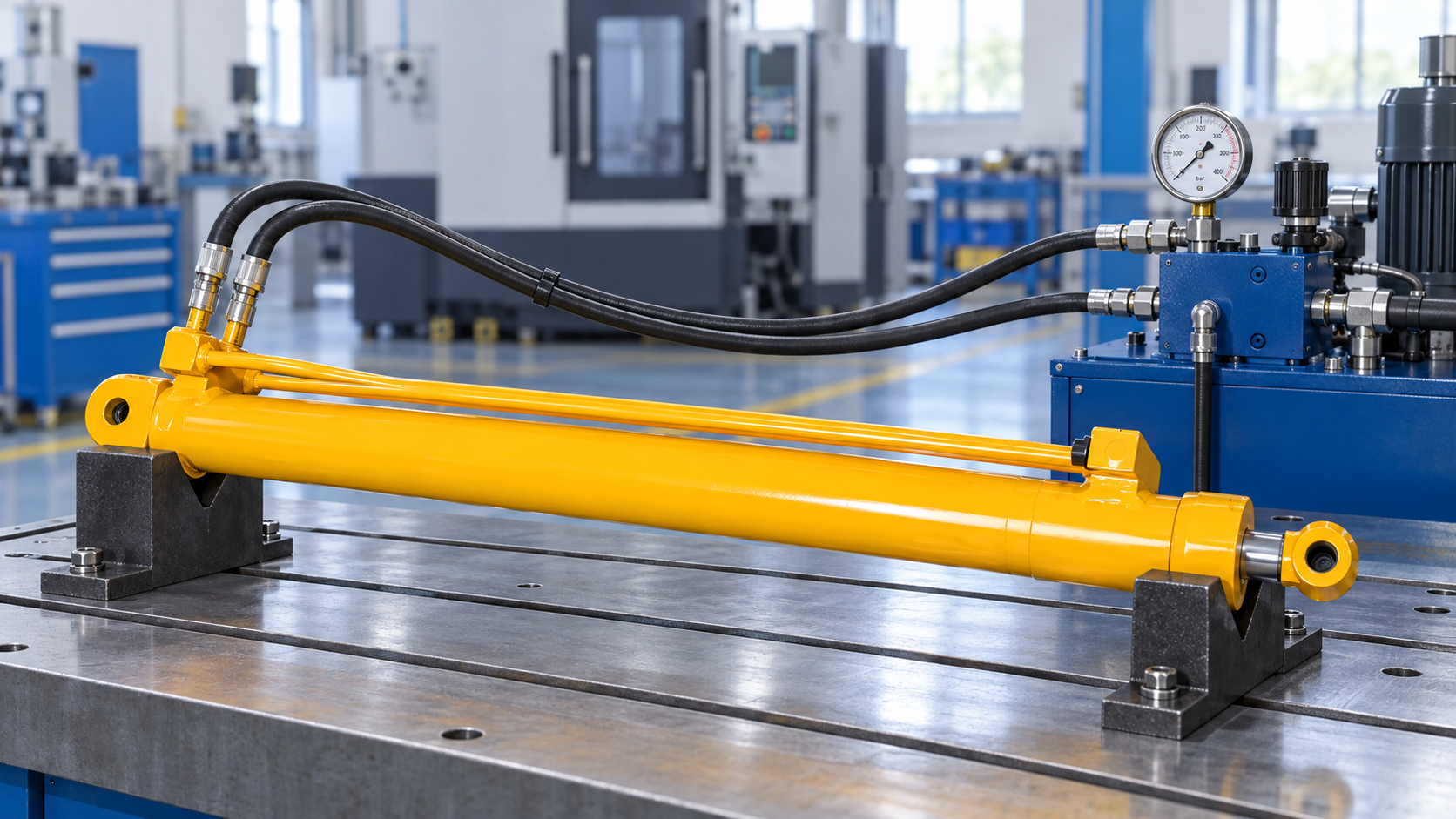
Watch an excavator pick up a bucket of soil. Your eye probably follows the bucket, not the polished rod moving beside its linkage. But the rod is what turns the bucket: it travels in a straight line, and the linkage turns that stroke into an arc. Inside the hydraulic cylinder, oil presses on a piston attached to the rod.
Follow that rod through a full cycle. Oil enters one side of the piston while oil leaves the other. Swap those paths, and the rod changes direction. That is the basic job of a double-acting Hyd Cylinder. The less obvious part is why it can push harder in one direction yet move faster in the other. The answer sits in the piston’s two working areas and the amount of oil flowing through the ports.
Inside the Hyd Cylinder
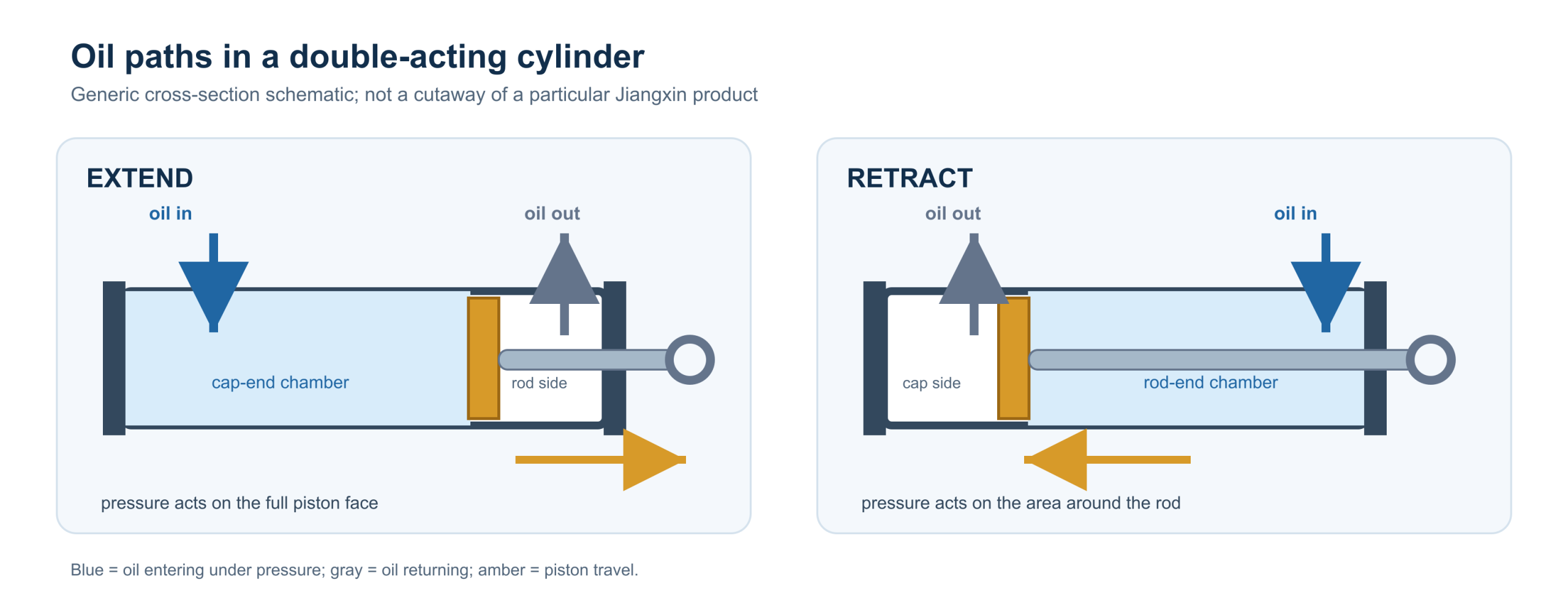
Imagine the barrel with its rod hidden inside. The rod is fixed to a piston that can slide along the bore. As it moves, the piston divides the barrel into two spaces: the cap-end chamber behind its full face and the rod-end chamber around the rod. Oil reaching either space pushes on the piston and moves the rod with it.
The seals have different jobs. A piston seal limits oil slipping from one chamber to the other. At the head, a rod seal keeps oil in, a wiper clears dirt from the returning rod, and guide rings help the rod travel straight. The two ports connect those chambers to the machine’s oil lines, while the mounts transfer the rod’s push or pull to the linkage. If you want to see how the barrel, rod, and seals are made and fitted, our hydraulic cylinder manufacturing process article follows them through the workshop.
Oil Paths Through the Cylinder
When the rod extends
To send the rod out, the control valve directs oil to the cap-end port. Oil presses against the piston’s full circular face, moving the piston toward the head. Oil already in the rod-end chamber needs somewhere to go, so it flows out through the other port and back toward the reservoir. Both lines are working at once: one feeds the moving chamber, and the other lets the opposite chamber empty.
When the rod comes back
Move the valve the other way and the oil paths reverse. Oil enters the chamber around the rod, pushing on the ring-shaped area of the piston. Oil at the cap end leaves through its port. Pressure does not pull the piston back; it pushes from the opposite side, taking the rod into the barrel. The diagram below lets you trace both paths at a glance.
If you know the oil pressure, can you work out how much force the rod will push? Not without the piston area. Oil pressure acts across that area, and the rod takes up part of it on the return side. Enerpac explains the pressure principle, while Yuken’s hydraulics manual gives the cylinder calculation:
Theoretical force = pressure × effective piston area
Here is a simple example, not a specification for the photographed Jiangxin product. Give a cylinder a 100 mm bore, a 50 mm rod, and 160 bar at the working port. On extension, oil sees about 7,854 mm² of piston area, so theoretical rod force is 125.7 kN. On retraction, the rod occupies 1,963 mm² of that face. Oil has only about 5,890 mm² to push against, giving 94.2 kN at the same pressure. To check those figures in metric units, multiply bar by mm² and divide by 10,000 for kN.
That difference is built into a single-rod cylinder. It does not mean a machine delivers exactly 125.7 kN at the bucket or fork. Pressure in the line emptying the opposite chamber resists movement, seals add friction, and the linkage changes force at the load as its angle changes. If you are sizing a cylinder for a machine, use pressure measured at its ports and the actual linkage drawing, not a pump rating alone.
How Fast Can the Cylinder Move?
Think about how much oil each side needs for the same distance of rod travel. The cap end has a larger working area, so it needs more oil for each millimeter of extension. The rod side has less space to fill. That is why a cylinder can retract faster than it extends when the same flow reaches either active port. HAWE’s cylinder-velocity reference expresses ideal speed as flow divided by effective piston area.
Use the same example: 100 mm bore, 50 mm rod, with 20 L/min actually arriving at the active port. Ideal extension speed is about 42 mm/s; ideal retraction speed is about 57 mm/s. Turning up pressure while keeping port flow unchanged does not automatically make either stroke faster. The pump and valve must deliver enough flow under load, and restrictions or leakage can change the speed you see on the machine.
Some cylinders ease into the end of a stroke because built-in cushioning meters oil leaving the opposite chamber. That slowdown can be intentional. When we discuss a custom hydraulic cylinder, your required travel time and available port flow tell us more about speed than the pressure rating alone.
One or Two Powered Cylinder Strokes?
Not every cylinder uses oil to move both ways. A double-acting cylinder has a working port on each side of the piston. A forklift tilt cylinder, for example, needs controlled forward and backward mast movement; Ognibene documents a double-acting tilt design. Jiangxin’s forklift cylinder range also separates lift, tilt, reach, and steering applications rather than treating them as one interchangeable cylinder.
A single-acting cylinder uses oil pressure for one powered stroke. A spring, gravity, or the load returns it as oil leaves through its working port. Forklift lifting is a familiar case: HydraForce describes a typical single-acting lift circuit. A telescopic cylinder can also be single- or double-acting; its nested stages tell you how far it can reach from a short closed length, not what powers its return. Check the drawing and circuit before assuming a second port or a powered return.
Hyd Cylinder Questions
Can a cylinder stop halfway and hold a load?
You can stop the rod before the end of its stroke by stopping flow through the directional valve. Whether it will hold a load is another matter. Valve position, internal leakage, and load-control devices all affect that. Never rely on the cylinder alone to support raised equipment while you work beneath it; follow the machine maker’s blocking procedure.
How much oil does one stroke need?
Multiply the effective piston area by the stroke length. For the illustrative cylinder above, a 100 mm extension needs about 0.785 L at the cap end. A 100 mm retraction with the 50 mm rod needs about 0.589 L at the rod end. If you know the flow reaching the port, those volumes also give you an ideal travel-time estimate.
Why does a cylinder slow just before it stops?
Look for an end-of-stroke cushion in the cylinder drawing. A cushion meters outgoing oil over the final part of travel, letting the piston reach the end more gently. Valve commands and changing linkage load can affect speed too, so check those before deciding what caused the slowdown.