
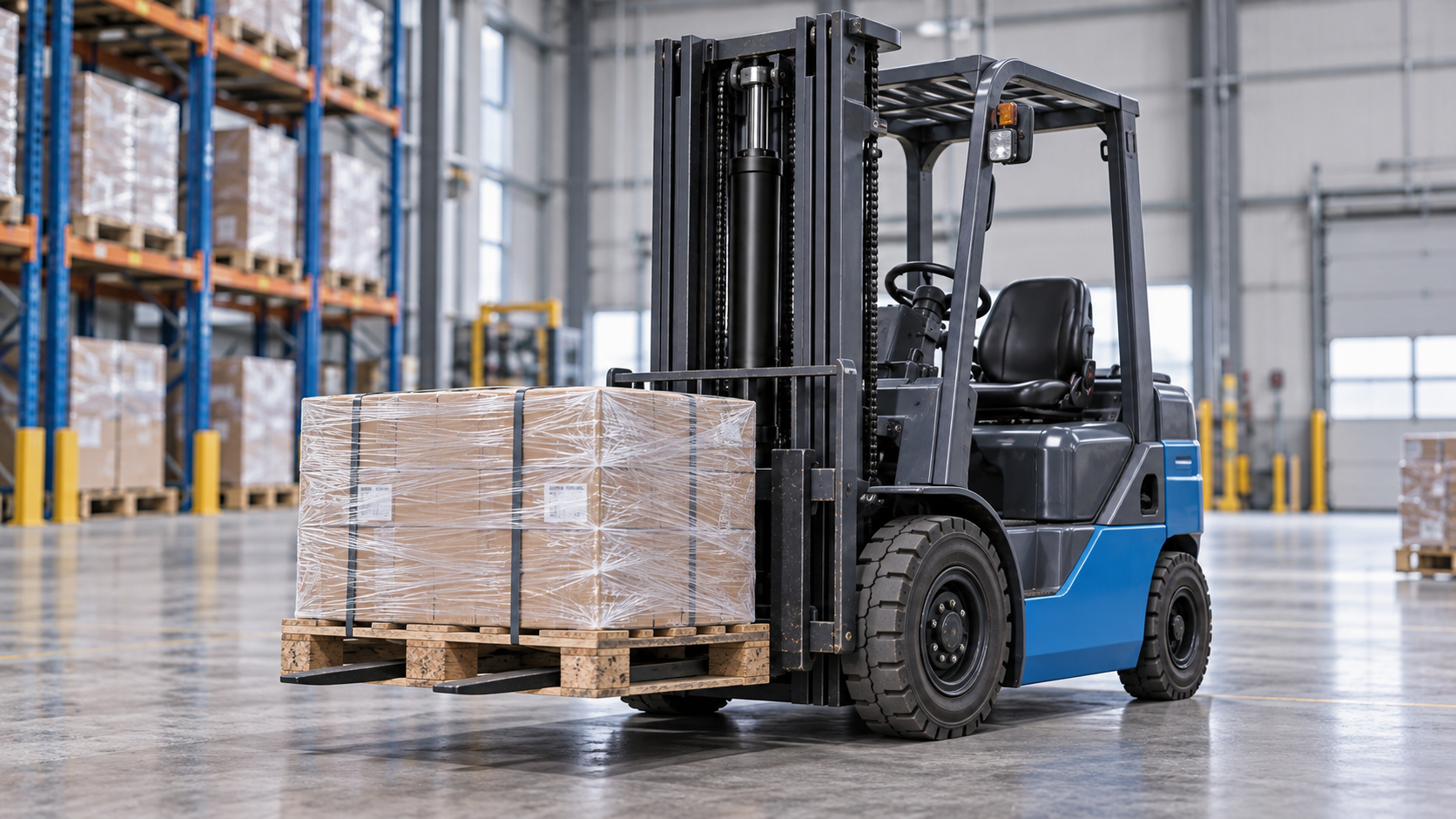
What does a hydraulic ram actually do in a machine? A forklift uses one to raise its fork carriage. A production line uses another to push a tray into position. On construction equipment, a cylinder can extend an outrigger beam. In each case, pressurized oil makes a piston or plunger move in a straight line. The type you need depends on the movement, how far it must travel, and how it returns.
How Does a Hydraulic Ram Work?
Oil enters the cylinder through a port and presses against a piston or plunger. That pushes the rod outward, lifting a carriage or moving a part along a guide. A valve controls where the oil goes next, so the machine can lower the load or retract the rod for another cycle.
Some rams use oil pressure for the outward stroke and rely on a load or spring to return. Others use oil pressure in both directions. That difference leads to the main types you’ll see on real machines.
What Types of Hydraulic Rams Are There?
You can group hydraulic rams by how they move or by how they are built. Single-acting and double-acting describe whether oil powers one stroke or both. Telescopic describes a cylinder with nested sections that extend from a shorter closed length. A telescopic ram can also be single- or double-acting.
Single-acting hydraulic ram
Oil pressure powers one stroke; the load, a spring or another mechanism brings the moving part back. A plunger ram is one single-acting design. It makes sense for lifting or pressing when that outside force can reliably return it. Before choosing one, ask what brings it back at every point in the cycle—not just when the machine is fully loaded.
Double-acting hydraulic ram
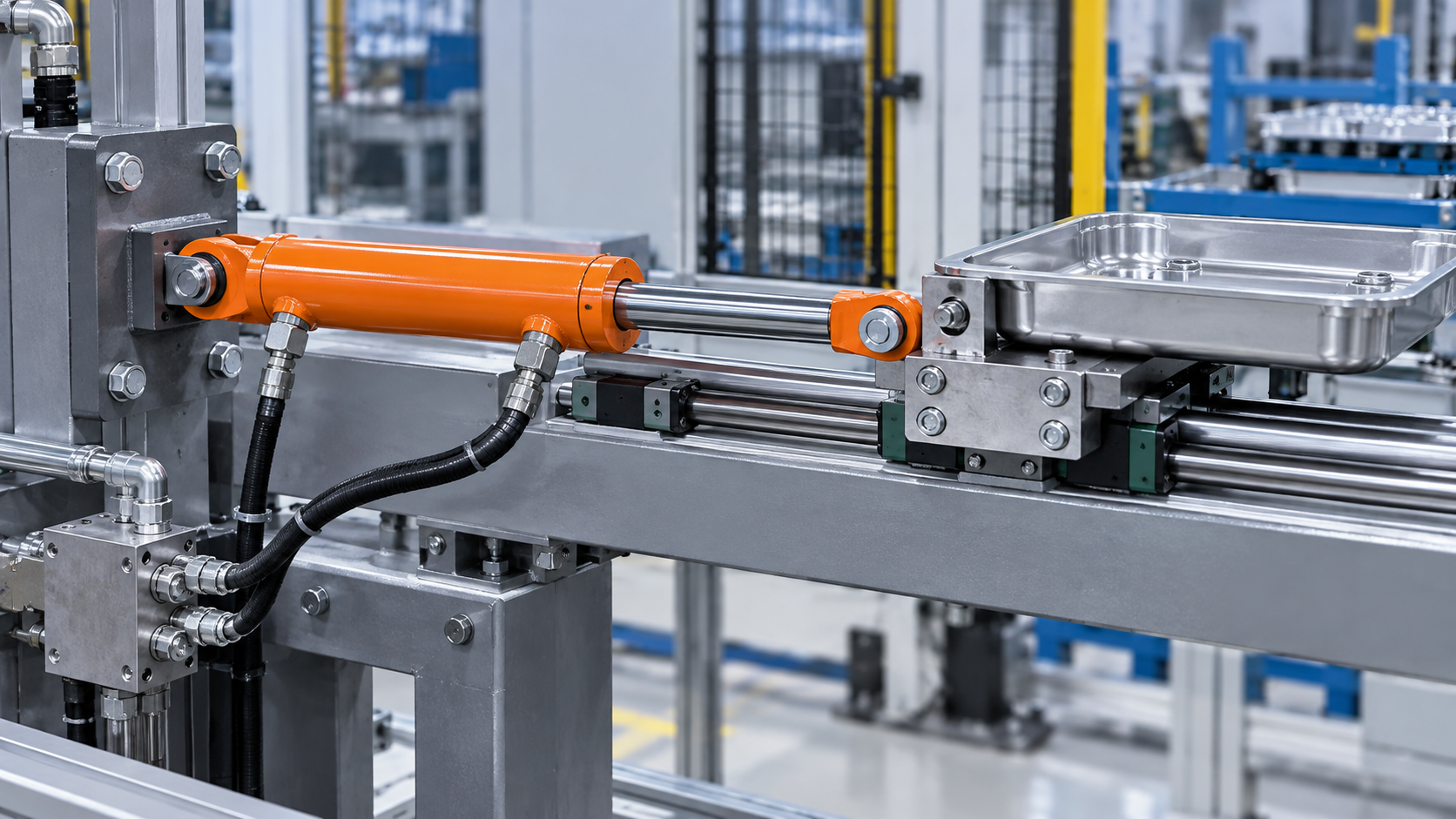
When you need a powered push and a powered pull, you’re usually looking at a double-acting cylinder. Oil acts on one side of the piston to extend the rod, then on the other side to retract it. A production-line pusher, for example, must move a part out and then clear the path for the next one. Jiangxin’s hydraulic pusher cylinder is offered for transfer, positioning, and ejection in automated lines. In that setting, return speed and repeatability matter as much as the forward push.
Telescopic hydraulic ram
A telescopic actuator nests several moving stages inside one another. It offers a long extended reach without requiring a one-piece cylinder of the same closed length. That is why telescopic designs suit equipment with limited stowed space, such as a tipping body. The trade-off is that available force changes as smaller stages extend; Enerpac’s telescopic-cylinder discussion notes the reduced load capacity farther out. You need enough force at the least favorable stage, not merely at the start of travel.
Where Are Hydraulic Rams Used?
You’ll find hydraulic cylinders doing different jobs in a warehouse, factory or on construction equipment. What changes from one job to the next is the movement the machine needs.
In a factory transfer station, a cylinder pushes a tray or workpiece into position and retracts before the next cycle. You care about the actual travel, the time allowed in each direction and how the moving part is guided. The cylinder supplies the push; it should not be asked to act as the carriage guide. Jiangxin’s automation-line pusher is one example of that role.
In a lift, the cylinder raises a load through a defined stroke. Forklift lifting cylinders do this in a mast; an automation-line lifting cylinder may instead raise a fixture or carrier at a fixed station. Both are lifting applications, but their mounting space, guidance and load-holding arrangements differ. Calling both “lift rams” does not tell you enough to swap one for the other.
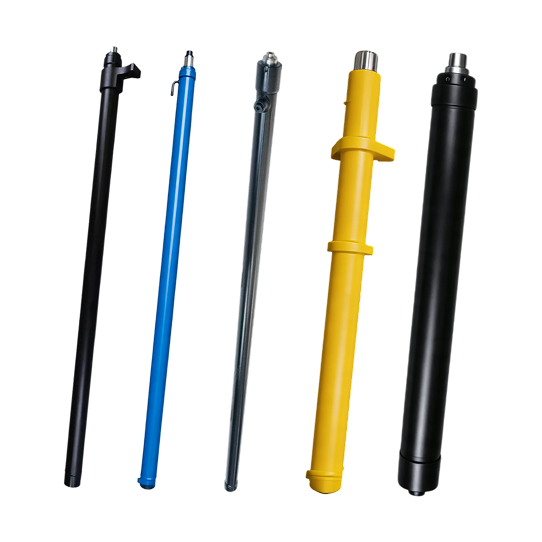
On construction equipment, a hydraulic cylinder may move an outrigger beam sideways before the vertical support leg contacts the ground. Jiangxin’s horizontal outrigger cylinder is for that beam extension and retraction—not for jacking the machine upward. A telescopic cylinder in a tipping body solves a different problem again: gaining long lift travel from a compact resting length.
How Do You Choose the Right Hydraulic Ram?
Start with the motion. If you need a powered return, a gravity-return plunger is a poor fit. If the machine only needs to lift and the load provides a dependable return, a single-acting design may be enough. If it must travel far but fit into a short stowed space, consider a telescopic arrangement and check force through the full extension.
Then look at what the cylinder is actually pushing. The required force depends on more than the object’s weight: friction, the angle of movement and the geometry of a linkage can all change the load seen by the rod. The stroke must cover the useful travel without running the machine into its end stops. A long exposed rod also needs a suitable mounting and guidance arrangement; side load is a job for the machine structure, not the rod seal.
Finally, think about what happens when movement stops. Does the load need to stay raised? Must the cylinder stop gently near the end of its stroke? Will dust, washdown or frequent cycling affect the rod and seals? Those answers shape the complete hydraulic setup, not just the cylinder body. If you’re comparing custom hydraulic cylinders, describe the job in those terms and it becomes much easier to identify a suitable design.
Two cylinders with the same nominal force and stroke can behave very differently in the same machine. Before choosing one, look at how it returns, how much room it has when retracted and what load it faces throughout the stroke.
Hydraulic Ram FAQ
Can a hydraulic ram work horizontally?
Yes. A double-acting cylinder can push a horizontal load out and pull it back under hydraulic power. A single-acting plunger can also push horizontally, but it needs a spring or another external mechanism to return it; gravity alone will not pull it back along a level path.
Will a hydraulic ram hold a load when the pump stops?
Don’t assume it will. A cylinder supplies force while the circuit controls the oil. If a raised load must remain in place, the machine needs an appropriate load-holding arrangement, such as a suitable valve or mechanical support. The cylinder’s lifting capacity alone does not answer that question.
How much weight can a hydraulic ram lift?
No single load rating applies to every ram. The available force depends on its working area and operating pressure, while the machine’s mounting and structure also limit what it can lift safely. Use the rating for the complete lifting setup, not the cylinder’s force alone.