
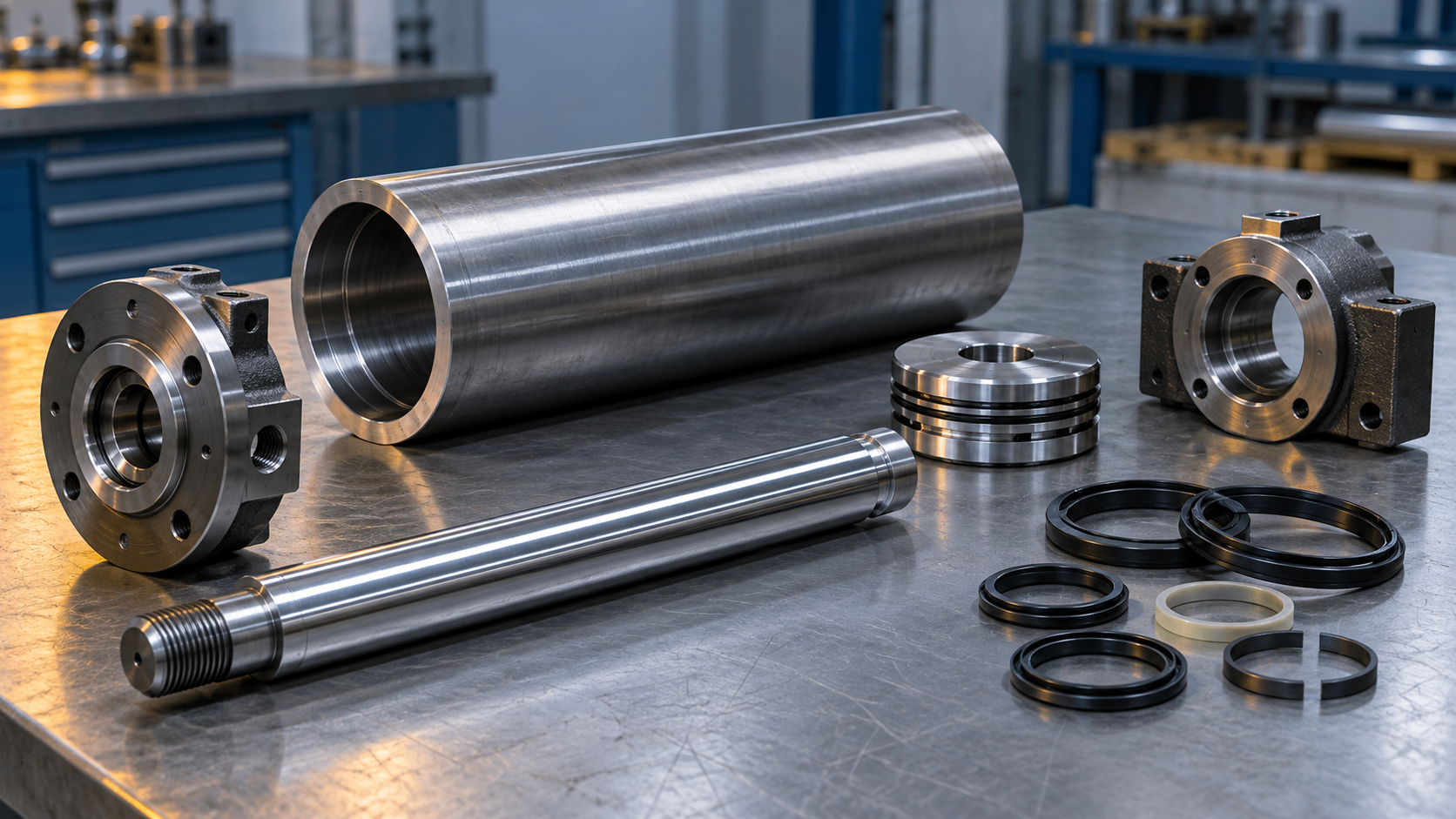
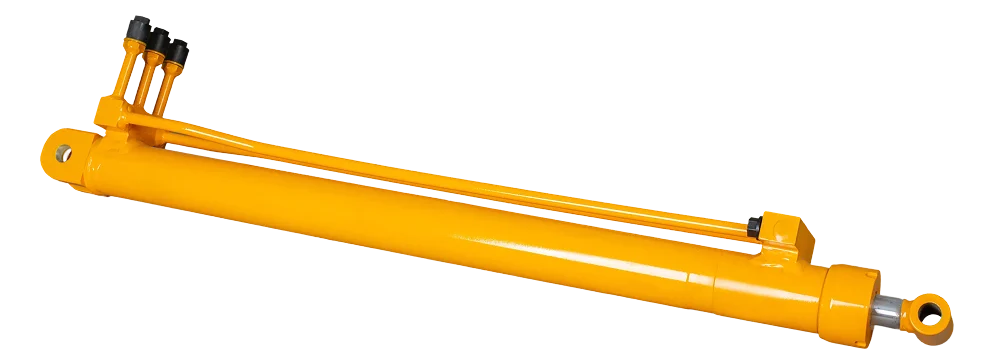
What actually happens inside a hydraulic cylinder when you operate the machine? Pressurized oil moves the piston, and the rod carries that movement to the load. The barrel contains the oil; the head and base close the cylinder, and seals and guides help the moving parts work together. Here are five groups of parts in a conventional piston-and-rod cylinder, starting with what you can see from the outside.
Hydraulic Cylinder Barrel
The barrel is the main steel tube between the end closures. Its inside surface gives the piston a smooth path to travel and holds pressurized oil in the working chambers. You usually see the outside of the barrel, but you cannot judge the condition of its bore from a quick external look. In the Bosch Rexroth hydraulics reference, this tube is labeled the cylinder pipe in a typical double-acting layout.
If you see a dent or a serious impact mark on the barrel, do not assume it is cosmetic: the inner running surface may also be affected. A cylinder that binds or moves unevenly might have bore damage, although misalignment or contamination can feel similar.
Hydraulic Cylinder Piston
Inside a conventional double-acting cylinder, the piston travels in the barrel and separates the two oil chambers. The pressure difference across it creates the push or pull at the rod. A piston seal helps keep oil from slipping directly from one side to the other; the piston and seal are different parts, even when you talk about them together.
You cannot see the piston while the cylinder is assembled. If a load drifts when it should hold, internal leakage past the piston seal may be one cause. Leakage through a control valve or elsewhere in the circuit can look much the same, so drift is a clue, not proof. Keep people clear of the load and have it supported as the machine maker specifies before anyone inspects the cylinder. Our separate guide to how a hydraulic cylinder works covers the oil-path sequence; here, the useful point is what the hidden divider does.
Do not apply this layout blindly to every product called a ram. Parker’s fluid-power sealing guide distinguishes piston-style cylinders from plunger arrangements that do not use the same piston-and-rod construction.
Hydraulic Cylinder Piston Rod
The piston rod connects the moving piston to the machine outside the barrel. Its polished surface passes through the rod-end head each time the cylinder extends or retracts. That exposed length is where you can spot a nick, rust, or recurring drops of oil before you know what is happening inside. A light lubricating sheen by itself is not the same as an external leak.
A scratch on the rod may cut or wear the rod seal as it travels through it. Repeated wet buildup or drops along the rod may point to that seal, but surface damage and the actual leak origin matter too. A bent rod or side load can make the motion feel tight and may increase wear at the head; neither symptom identifies a single failed part by itself. If you are comparing an application-specific unit, Jiangxin’s custom hydraulic cylinder range is a better reference than assuming every rod has the same mounting and stroke.
Hydraulic Cylinder Head and Base
The head closes the rod end of the barrel and provides the passage and support for the rod. The base closes the opposite end and often carries a mounting point. Ports, seals, and fastening details vary by design, so treat these as two functional ends, not as a universal parts list. Bosch Rexroth labels both ends separately in its standard cylinder drawing.
If oil appears around an end joint or a port, the source may be a static seal, a fitting, or damage nearby. Where the oil first wets the metal matters more than where it finally drips. At the rod end, looseness or uneven rod contact may also involve the head’s guiding parts.
Hydraulic Cylinder Seals, Guides, and Wipers
This fifth group contains several small parts, not one interchangeable item. A piston seal limits leakage between chambers. A rod seal keeps oil inside as the rod moves out. A wiper scrapes dirt from the returning rod, while guide or wear rings carry side load and help keep metal surfaces apart. SKF’s hydraulic cylinder seal guides make these functions distinct.
You might see persistent wet buildup at the rod end, dirt gathering at the head, or a change in how smoothly the rod moves. Those signs can suggest a seal, wiper, or guide problem, but they can also start with a scored rod, side load, or dirty oil. In a working machine, the small parts are only as effective as the surfaces and alignment around them.
If you are discussing a replacement or new build with us, share the cylinder model, dimensions, operating pressure, fluid, and the trouble you are seeing. Those details help us connect the symptom to the right design.
Hydraulic Cylinder Components FAQ
Is the piston the same as the piston rod?
No. The piston moves inside the barrel and divides the chambers; the rod links it to the external load.
Why do drops collect at the rod end?
Recurring drops can point to a worn rod seal or damaged rod surface; a light lubricating film alone is not proof of a leak.
Can a drifting cylinder mean a bad piston seal?
Yes, but it can also mean leakage elsewhere in the hydraulic circuit. Drift alone does not isolate the fault.
What keeps dirt out of a hydraulic cylinder?
The rod-end wiper helps clear contamination from the rod as it retracts; sound seals and a clean system matter too.