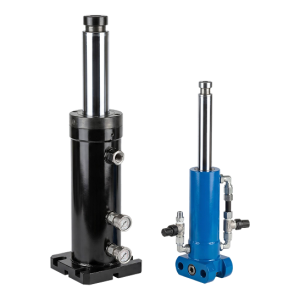


Station fit
Confirm stroke, closed height, mounts and port clearance from the assembly drawing.

This cylinder raises a work carrier, fixture or tooling plate. Selection depends on the moving mass, stroke, installed height, pressure, speed and duty cycle.
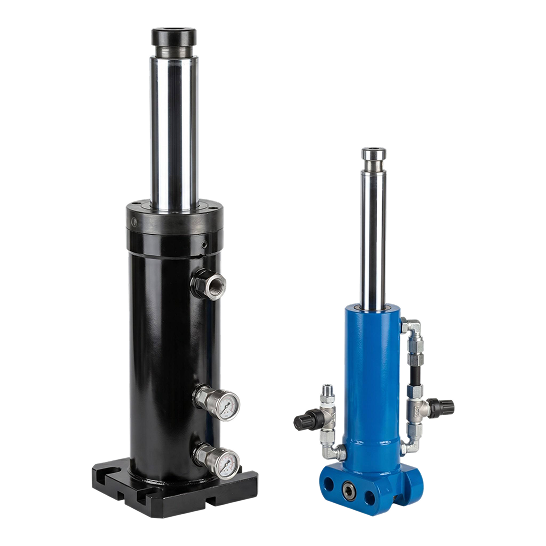
Confirm stroke, closed height, mounts and port clearance from the assembly drawing.
The machine structure guides the load and controls synchronization between lift points.
For replacements, provide the part number, key dimensions and installed photos.
| Category | Requirements | Purpose |
|---|---|---|
| Moving assembly | Fixture or carrier mass, maximum payload, center of gravity, friction and any process force applied in the raised position. | Separates the moving load from side force, impact and other machine reactions. |
| Cylinder quantity and orientation | Number of cylinders, vertical or inclined installation, push or pull direction and a section view of the mechanism. | Defines how load is shared and whether each rod remains axially loaded. |
| Stroke and height references | Usable stroke, retracted and extended datum dimensions, approach clearance, overtravel allowance and external stop locations. | Prevents a correct stroke from being paired with the wrong installed length. |
| Bore, rod and pressure | Available working pressure, return pressure, requested bore and rod size when known, plus the design load or force case. | Lets us check force direction, pressure basis and rod stability together. |
| Base and rod interfaces | Flange or foot dimensions, bolt pattern, pilot diameter, rod thread or contact pad, alignment datums and allowable envelope. | Controls fit, load transfer and service access inside the station. |
| Ports and plumbing | Port standard, size, orientation, hose or manifold connection, valve location and clearance for fittings and tools. | Avoids a port arrangement that conflicts with the frame or guarding. |
| Motion timing | Raise and lower time, permitted acceleration and deceleration, available flow and required speed near each end position. | Connects the cylinder volume to the valve, pump and machine cycle. |
| Cycle profile | Cycles per minute or hour, dwell under load, operating hours per shift, fluid temperature and ambient temperature. | Gives us a measurable duty cycle for seal and thermal review. |
| Holding and failure response | Permitted drift, hold time, trapped-load case, pressure-loss response, guarding and any mechanical support or lock. | Separates motion generation from the machine's load-holding and safety functions. |
| Environment and acceptance | Fluid type, contamination exposure, washdown or dust conditions, finish requirement, inspection documents and test criteria. | Defines materials, protection and the evidence required before shipment. |
We compare the required push or pull force with the usable pressure range, return-side pressure and the machine designer's allowance for friction and acceleration. Tell us whether the stated load is normal, maximum or an abnormal case so the quotation is tied to the correct condition.
A long extended rod behaves differently from a short compact installation. Give us the unsupported length, end restraint, mounting orientation and possible offset. We use those inputs to review rod diameter and the need for external guidance without assuming the rod can carry lateral machine loads.
We check the base register, bolt pattern, rod-end contact and alignment datums shown on your drawing. If the machine frame can deflect or the guided table can bind, identify the expected misalignment and how the mechanism accommodates it before the interface is released.
State the maximum lowering speed, permissible drift and what the station must do after loss of pump pressure or electrical power. The circuit designer can then define any load-control valve, monitored stop or mechanical support as part of the complete machine risk assessment.
It raises fixtures, tooling plates, pallet nests or work carriers in fixed production stations.
No. Stroke, installed height, pressure, load position, speed and duty cycle also affect selection.
The machine structure should guide the table and resist side load while the cylinder supplies axial force.
Do not assume it will. Define permitted drift and the required load-control valve or mechanical support.